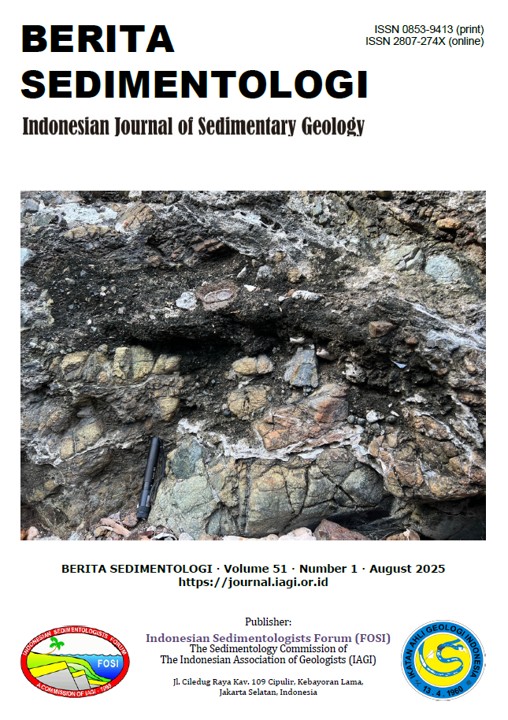
East Java Basin Carbonate Reservoirs: Time Control on Reservoir Character
DOI:
https://doi.org/10.51835/bsed.2025.51.1.462Keywords:
East Java, Ngimbang, Kujung, GlobigerinaAbstract
The East Java Basin, a prolific back-arc basin in Indonesia, hosts significant hydrocarbon accumulations within Cenozoic carbonate reservoirs. This study explores the link between carbonate age, fossil assemblages, and reservoir characteristics. The oldest reservoir, the Ngimbang Formation, dominated by large foraminifera and interbedded shale, exhibits limited vertical growth potential. Conversely, the Oligo-Miocene Kujung Formation, rich in coral reefs, boasts the basin's highest hydrocarbon content. Pliocene Globigerina sands offer excellent reservoir quality due to both inter- and intra-granular porosity, but their distribution is restricted. This work analyzes the variations in reservoir properties (porosity and permeability) influenced by these distinct fossil assemblages across the formations. Additionally, comparisons of formation geometries and their impact on hydrocarbon trapping are addressed. By understanding these factors, the paper explores the potential for identifying hidden reservoirs within the basin for future exploration.References
Ardhana, W., Lunt, Pl, Burgon, G.E, 1993, The Deep Marine Sand Facies of the Ngrayong Formation in the Tuban Block, East Java Basin; in Clastic Rocks and Reservoirs of Indonesia: A Core Workshop, Atkinson, C., Scott, J., Young, R. (eds.)
Arisandy, M., Abrar, B., Bahri, W., 2015, Limestone Diagenesis Reservoir Quality of CD Carbonate Formation East Java Basin, Proceedings of Indonesian Petroleum Association 39th Annual Convention.
BEICIP, 1985, Hydrocarbon Potential of Western Indonesia, Pertamina.
Bernama, 2023, Indonesia, Malaysia Cooperate in Exploiting Oil Field off Java Island, the Sun.
Damatra, A., Setyowiyoto, J., Barianto, D. H., 2017, Reservoir Characterization of Carbonate in Kujung Formation, Damatra Field, North East, Proceedings Joint Convention, Malang 2017, HAGI – IAGI – IAFMI- IATMI
Darman, H., Juliong, D., 2020, Sedimentary Basins of Indonesia: Outline and Thickness Variation Understanding, Berita Sedimentology, no. 45.
Darmawan, H. I., & Wijaya, A K., 2022, Characteristics of Eocene Carbonate Reservoir – A Case Study of Ngimbang Carbonate in North Madura Platform, East Java Basin, Proceedings of Indonesian Petroleum Association 46th Annual Convention.
Doust, H., & Noble, R. A., 2008, Petroleum Systems of Indonesia, Marine and Petroleum Geology 25, pp. 103–129
Edwin, A., Han, K., Nusantara, W., 2013, A Case Study on Using Mundu-Paciran Nannofossil Zones (MPNZ) to Subdivide Mundu and Paciran Sequences in the MDA Field, East Java Basin, Indonesia, Berita Sedimentologi Number 26, pp. 26-32.
Hadiyanto, N., Sartika, D. E Deliani, F., Takano, O., 2010, Integrated 3-D Static Reservoir Modeling of Upper Pliocene Paciran Carbonate in the Sirasun Gas Field, Kangean Block, East Java Basin, Proceedings of Indonesian Petroleum Association 34th Annual Convention.
Haribowo, N., Sagala, I., Nurul, N., 2022, Karst and Dolomitization Controlling Miocene Carbonate Reservoir Quality, Case Study of Carbonate Oil Discovery, East Java Basin, Indonesia, SEG-AAPG Image.
Howes, J.V.C., Tisnawijaya, S., 1995, Indonesian Petroleum Systems, Reserves Additions and Exploration Efficiency, Proceedings of Indonesian Petroleum Association 24th Annual Convention, pp. 1–17.
Kenyon, C.S., 1977. Distribution and Morphology of Early Miocene Reefs, East Java Sea, Proceedings 6th Indonesian Petroleum Association Convention, pp. 215–238.
Khaing, S. Y., Surjoni, S. S, Setyowiyoto, J., & Sugai, Y., 2017, Facies and Reservoir Characteristics of the Ngrayong Sandstone in the Rembang Area, Northeast Java (Indonesia), Open Journal of Geology, 7, 608-620. https://doi.org/10.4236/ojg.2017.75042.
KKPJM, 2021, Eastern Java Region, Integrated Geology & Geophysics Study, SKKMIGAS, Pertamina Hulu Energy, PT. Geoservices (unpublished report).
Koesoemadinata, R. P., 2020, An Introduction Into the Geology of Indonesia, Ikatan Alumni Teknik Geologi ITB.
Leprieru, F., Pellissier, L., Mouillot, D., Gabouriau, T., 2021, Infuence of Historical Changes in Tropical Reef Habitat on the Diversifcation of Coral Reef Fishes, Scientific Reports, nature portfolio.
Latief, R., Mey, P., Suseno, A., 1990, Madura Island, Post Convention Field Trip Guide Book, Indonesian Petroleum Association.
Luan, X., Lunt, P, 2021, Occurrence in Space and Time of the Globigerina-Sands of Eastern Java; Their Stratigraphy, and Controls on Reservoir Quality, Marine and Petroleum Geology, Volume 133, November 2021, https://doi.org/10.1016/j.marpetgeo.2021.105311
Luthfi, A., Biantoro, E., Satyana, A. H., 2003, Gas Habitat of the East Java Basin, Indonesia – Meets the Future Demand, EAGE 65th Conference & Exhibition, Stavanger, Norway
Lunt, P., 2013, The Sedimentary Geology of Java, Special Publication of the Indonesian Petroleum Association
Lunt, P., 2019, The Origin of the East Java Sea Basins Deduced from Sequence Stratigraphy, Marine and Petroleum Geology 105, 17–31.
Mansyur, M., Wooley, L. G., Nurhasan, 2017, Controlling Factor in Pliocene Carbonate Reservoir Quality as Key to Evaluate Play Chances: Case Study from Mundu Carbonate from South Madura Strait - East Java Basin, AAPG Search and Discovery Article #11007.
Mansyur, M., Prasetyo, J., Utama, M. K., 2019, Uncertainties in finding an underdeveloped Hydrocarbon Play in a mature Basin: Case study based on contrasting two Carbonates play from East Java Basin, Indonesia, AAPG Asia Pacific Technical Symposium, Bogor, (Greater Jakarta), Indonesia
Markello, J. R., Koepnick, R. B., Waite, L. E., 2006, The Carbonate Analogs Through Time (CATT) Hypothesis – A Systematic and Predictive Look at Phanerozoic Carbonate Reservoirs, AAPG Search and Discovery Article #40185
Markello, J. R., Koepnick, R. B., Waite, L. E., Collins, J., 2008, The Carbonate The Carbonate Analogs Through Time (CATT) Hypothesis and the Global Atlas of Carbonate Fields – A Systematic and Predictive Look at Phanerozoic Carbonate Systems; in Controls on Carbonate Platform and Reef Development, Lukasik, J. and Simo, J. A (eds.), SEPM Special Publication No. 89
Mudjiono, R., dan Pireno, G. E. 2002. Exploration of the North Madura Platform, Offshore East Java, Indonesia, Proceedings of Indonesian Petroleum Association 28th Annual Convention.
Nawawi, A., Suseno, A., Heriyanto, N. Abdullah, M., Mertani, B., Kohar, A., Ponto, C. V., Darman, H., Ardana, W., Caughey, C. A., Bachtiar, A., Natanegara, D., Harwijanto., 1996, Petroleum Geology of Indonesian Basins: East Java basins, Pertamina BPPKA.
Pamungkas, G. M., 2019, Hydrocarbon Accumulation Uncertainty in Miocene Carbonate Build-Ups, NEJB, AAPG Asia Pacific Region, The Art of Hydrocarbon Prediction: Managing Uncertainties, Bogor.
Purnama, Y. S,, Gunawan, A,, Darmawan, W., Rohmana, R C., Adipradipto, D, Halim, J., Julias, R. N., Rahmanto, B., 2018, Characters of Sedimentology, Rock Property and Geochemistry of the Ngrayong and Tuban Formations In The Pati Trough, Onshore North East Java Basin, Proceeding Indonesian Petroleum Association, 42nd Annual Convention.
Prasetya, A., Romi, S., Yumansa, A., Agustiana, R., Setiawan, M., Harun, N. M., 2017, An Incised Valley Filled System on a Ngimbang Limestone Sequence at JS-1 Ridge, Offshore East Java Basin, Indonesia.
Robertson Research, 1986, East Java and Java Sea Basinal Area: Stratigraphy, Petroleum Geochemistry and Petroleum Geology (unpublished report).
Satyana, A H., Purwaningsih, M. E. M., 2002, Geochemistry and Habitat of Oil and Gas in the East Java Basin: Regional Evaluation and New Observations, Indonesian Association Of Geologists 31st Annual Conference, Surabaya, pp. 68-102.
Satyana, A H., Purwaningsih, M. E. M., 2003, Geochemistry of the East Java Basin: New Observations on Oil Grouping Genetic Gas Types and Trends of Hydrocarbon Habitats.
Satyana, A.H., Erwanto, E., Prasetyadi, C,, 2004, Rembang-Madura-Kangean-Sakala (RMKS) Fault Zone, East Java Basin: The Origin and Nature of a Geologic Border, IAGI 33rd Annual Convention, Bandung
Schiller, D.M., B.W. Seubert, S. Musliki and M. Abdullah, 1994, The Reservoir Potential of Globigerinid Sand in Indonesia: Proceeding Indonesian Petroleum Association, 23rd Annual Convention, p. 189-212
Siemers, C. T., Deckelman, J. A., Brown, A. A., and West, E. R., 1992, Characteristics of the Fractured Ngimbang Carbonate East Java Sea, Indonesia (Eocene), West Kangean-2 Well, Kangean PSC; In Carbonate Rocks and Reservoirs of Indonesia: A Core Workshop, Longman. M. W., and Siemers, C. T. (eds.)
Simo, T., Sekti, R. P., Hakiki, F., Sun, M., Myers, R D., Fullmer, S., 2012, Reservoir Characterization and Simulation of an Oligocene-Miocene Isolated Carbonate Platform: Banyu Urip Field, East Java Basin, Indonesia, AAPG Search and Discovery Article #20159.
Soeka, S., Suminta, Siswoyo, 1982, The Miocene/Pliocene Boundary in the Northeast Java Basin, Indonesia, Scientific Contribution Volume 2, pp 3-15
Surjono, S. S., & Gunawan, M., 2018, Onshore-Offshore Facies Change of ngrayong Sandstone in Madura Area – Indonesia, ASEAN Engineering Journal, Vol 8 No 2; https://DOI:10.11113/aej.v8.15499
Tian, S. Y., Yasuhara, M., Conamione, F. L., Huang, H-H, M., Fernando, A. G. S., Aguilar, Y. M., Pandita, H., Irizuki, T., Iwatani, H., Shin, C. P., Renema, W., Kase, T, 2024, Cenozoic History of the Tropical Marine Biodiversity Hotspot, Nature, https://doi.org/10.1038/s41586-024-07617-4
Downloads
Published
How to Cite
Issue
Section
License
Licensing and Copyright Agreement
In submitting the manuscript to BERITA SEDIMENTOLOGI, the authors certify that:
- They are authorized by their co-authors to enter into these arrangements.
- The work described has not been formally published before, except in the form of an abstract or as part of a published lecture, review, thesis, or overlay journal.
- That it is not under consideration for publication elsewhere.
- That its publication has been approved by all the author(s) and by the responsible authorities – tacitly or explicitly – of the institutes where the work has been carried out.
- They secure the right to reproduce any material that has already been published or copyrighted elsewhere.
- They agree to the following license and copyright agreement.
Copyright
Authors who publish with BERITA SEDIMENTOLOGI agree to the following terms:
- Authors retain copyright and grant BERITA SEDIMENTOLOGI the right of first publication with the work simultaneously licensed under a Creative Common Attribution License (https://creativecommons.org/licenses/by-sa/4.0/) that allows others to share the work with an acknowledgement of the work’s authorship and initial publication in this journal.
- Authors are able to enter into separate, additional contractual arrangements for the non-exclusive distribution of the journal's published version of the work (e.g. post it to an institutional repository or publish it in a book), with an acknowledgement of its initial publication in this journal.
- Authors are permitted and encouraged to post their work online (e.g. in institutional repositories or on their website) prior to and during the submission process, as it can lead to productive exchanges, as well as earlier and greater citation of published work.
Non-Exclusive Commercial License
Forum Sedimentologiwan Indonesia (FOSI) and Ikatan Ahli Geologi Indonesia (IAGI), as the publishers of BERITA SEDIMENTOLOGI, occasionally will compile previously published volumes, reproduce them and put the copies into a media (e.g. DVD or USB drive) that later can be sold in exchange for a small amount of fees. The fees are not meant to gain profit from this journal publication, however they are to cover the production cost only.
By publishing with BERITA SEDIMENTOLOGI, the Authors agree to grant this journal and its publisher a Non-Exclusive Commercial License to compile, reproduce and sell the publication copies in a DVD or USB drive media and will not claim any rights/shares from the generated income in the future.