Sedimentary facies and depositional environments of the Halang Formation in the North Serayu Basin: Insights from outcrop study in Bantarbolang, Pemalang, Central Java
DOI:
https://doi.org/10.51835/bsed.2024.50.1.447Keywords:
Halang Formation, North Serayu Basin, turbidite deposits, submarine fanAbstract
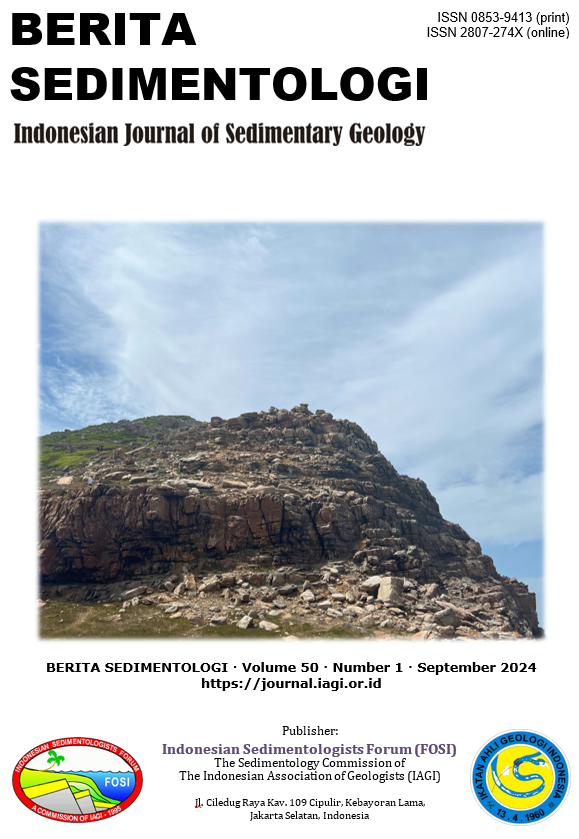
Halang Formation has been the subject of extensive research due to its unique characteristics, particularly its turbidite facies, which indicate deposition in deep marine environments. Previous studies have revealed a complex lithological composition, including sandstone, calcareous sandstone, claystone, marl, tuff, and breccia, with an upward coarsening pattern indicative of progradation processes. The presence of Bouma’s sequence further confirms the dominance of turbidite deposits within the formation. This research aims to define the depositional environment of the Halang Formation through detailed lithofacies and microfossil analyses, focusing on a previously understudied area in the North Serayu Basin. By integrating data from field observations and micropaleontological analysis, this study seeks to provide valuable insights into the sedimentary processes and paleoenvironments that formed the Halang Formation. Our findings indicate that the formation was deposited in a submarine fan environment, specifically in the smooth portion of suprafan lobes, which are characterized by dominant classical turbidite (CT) facies. Micropaleontological analysis suggests an inner to outer bathyal environment at depths ranging from 283.65 to 713.7 meters. These results contribute to our understanding of the Halang Formation depositional history and the broader geological evolution of the North Serayu Basin.
References
Armandita, C., Mukti, M. M. and Satyana, A. H., 2009. ‘Intra-arc trans-tension duplex of Majalengka to Banyumas Area: prolific petroleum seeps and opportunities in West-Central Java border’. Proceedings of IPA 33rd Annual Convention. Indonesian Petroleum Association.
Asikin, S. et al., 1992. Peta Geologi Lembar Banyumas, Jawa, skala 1: 100.000. Pusat Penelitian dan Pengembangan Geologi, Bandung.
Bouma, A. H., 1962. ‘Sedimentology of some flysch deposits’, Agraphic approach to facies interpretation, 168.
Hall, R., 2012. ‘Late Jurassic–Cenozoic reconstructions of the Indonesian region and the Indian Ocean’, Tectonophysics, 570–571, pp. 1–41. doi: https://doi.org/10.1016/j.tecto.2012.04.021.
Husein, S. et al., 2013. ‘Kendali stratigrafi dan struktur gravitasi pada rembesan hidrokarbon Sijenggung, Cekungan Serayu Utara’, in Prosiding Seminar Nasional Kebumian ke-6 Jurusan Teknik Geologi Fakultas Teknik Universitas Gadjah Mada, Yogyakarta, pp. 474–489.
Mukti, M. M. and Ito, M., 2010. ‘Discovery of outcrop-scale fine-grained sediment waves in the lower Halang Formation, an upper Miocene submarine-fan succession in West Java’, Sedimentary Geology, 231(3–4), pp. 55–62.
Praptisih, P. and Kamtono, K., 2011. ‘Turbidite Facies of the Halang Formation in Ajibarang Area, Central Java’, Indonesian Journal on Geoscience, 6(1), pp. 13–27.
Prasetyadi, C., 2007. Evolusi tektonik Paleogen Jawa bagian timur. Doctoral Dissertation, Institut Teknologi Bandung.
Satyana, A. H. and Armandita, C., 2004. ‘Deepwater plays of Java, Indonesia: Regional evaluation on opportunities and risks’, in IPA-AAPG Deepwater and Frontier Symposium, pp. 293–319.
Shanmugam, G., 2000. ‘50 years of the turbidite paradigm (1950s—1990s): deep-water processes and facies models—a critical perspective’, Marine and Petroleum Geology, 17(2), pp. 285–342.
Walker, R. G., 1978. ‘Deep-Water Sandstone Facies and Ancient Submarine Fans: Models for Exploration for Stratigraphic Traps’, AAPG Bulletin, 62(6), pp. 932–966. doi: 10.1306/C1EA4F77-16C9-11D7-8645000102C1865D.
Downloads
Published
How to Cite
Issue
Section
License
Licensing and Copyright Agreement
In submitting the manuscript to BERITA SEDIMENTOLOGI, the authors certify that:
- They are authorized by their co-authors to enter into these arrangements.
- The work described has not been formally published before, except in the form of an abstract or as part of a published lecture, review, thesis, or overlay journal.
- That it is not under consideration for publication elsewhere.
- That its publication has been approved by all the author(s) and by the responsible authorities – tacitly or explicitly – of the institutes where the work has been carried out.
- They secure the right to reproduce any material that has already been published or copyrighted elsewhere.
- They agree to the following license and copyright agreement.
Copyright
Authors who publish with BERITA SEDIMENTOLOGI agree to the following terms:
- Authors retain copyright and grant BERITA SEDIMENTOLOGI the right of first publication with the work simultaneously licensed under a Creative Common Attribution License (https://creativecommons.org/licenses/by-sa/4.0/) that allows others to share the work with an acknowledgement of the work’s authorship and initial publication in this journal.
- Authors are able to enter into separate, additional contractual arrangements for the non-exclusive distribution of the journal's published version of the work (e.g. post it to an institutional repository or publish it in a book), with an acknowledgement of its initial publication in this journal.
- Authors are permitted and encouraged to post their work online (e.g. in institutional repositories or on their website) prior to and during the submission process, as it can lead to productive exchanges, as well as earlier and greater citation of published work.
Non-Exclusive Commercial License
Forum Sedimentologiwan Indonesia (FOSI) and Ikatan Ahli Geologi Indonesia (IAGI), as the publishers of BERITA SEDIMENTOLOGI, occasionally will compile previously published volumes, reproduce them and put the copies into a media (e.g. DVD or USB drive) that later can be sold in exchange for a small amount of fees. The fees are not meant to gain profit from this journal publication, however they are to cover the production cost only.
By publishing with BERITA SEDIMENTOLOGI, the Authors agree to grant this journal and its publisher a Non-Exclusive Commercial License to compile, reproduce and sell the publication copies in a DVD or USB drive media and will not claim any rights/shares from the generated income in the future.